

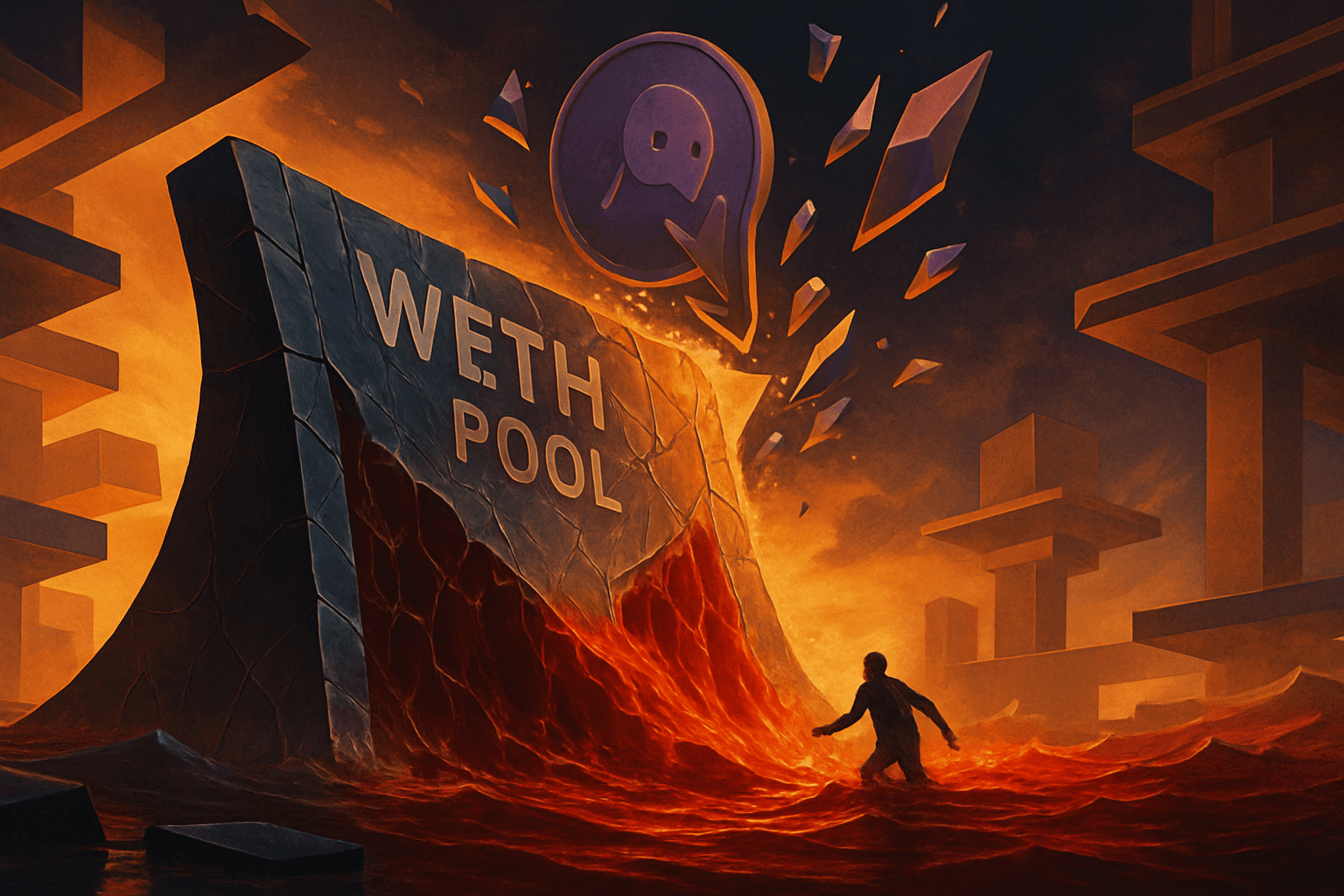
KelpDAO rsETH Exploit Creates $280M Bad Debt in Aave WETH Pool; AAVE Drops 12%
A KelpDAO exploit targeting rsETH has created $280M in bad debt inside Aave's WETH lending pool, sending AAVE down 12% and prompting urgent warnings for WETH suppliers to withdraw before Umbrella settlement activates.
KelpDAO rsETH Exploit Creates $280M Bad Debt in Aave WETH Pool; AAVE Drops 12%
A KelpDAO exploit targeting rsETH has created $280 million in bad debt inside Aave's WETH lending pool, sending the AAVE token down 12% and prompting urgent warnings for WETH suppliers to withdraw funds before the protocol's Umbrella settlement mechanism processes claims.
The exploit struck KelpDAO's rsETH, a liquid restaking token (LRT) representing ETH deposited through restaking infrastructure built on Ethereum. Liquid restaking tokens let users earn staking yields while keeping capital mobile, but they introduce layered smart contract risk. Because Aave accepts rsETH as collateral in its WETH lending pool, the damage did not stay contained within KelpDAO. It cascaded directly into one of DeFi's largest lending platforms, leaving the pool carrying bad debt: outstanding loans that can no longer be fully backed by solvent collateral.
Aave's Umbrella system, the protocol's insurance and shortfall settlement layer, is expected to absorb a portion of the losses. Suppliers providing WETH liquidity to the affected pool are being urged to withdraw before Umbrella processes its claims. The urgency comes from how shortfall settlement works: once Umbrella activates, the recovery process can dilute or delay returns for remaining depositors depending on how losses are distributed. Withdrawing ahead of settlement gives suppliers a cleaner exit. Aave's multi-collateral architecture means other lending pools remain unaffected, but that distinction offers limited comfort to WETH depositors currently exposed.
The AAVE token's 12% decline reflects market concern about protocol-level contagion rather than a fundamental breakdown of Aave itself. Whether that sell-off is proportionate depends on the actual size of the bad debt relative to total WETH pool liquidity, a figure not independently verified at the time of writing. If the bad debt represents a small fraction of overall pool depth, the price reaction may prove excessive. DeFi markets have historically overshot on exploit news before recovering as the scope of damage becomes clearer. The speed of the decline signals that institutional and retail participants are treating this as a material risk event, not a minor accounting adjustment.
The incident fits a well-documented pattern. The 2023 Curve Finance exploit showed how a single vulnerability in a widely integrated protocol could ripple across lending markets, liquidity pools, and governance tokens simultaneously. Liquid staking and restaking derivatives have amplified this interconnectedness. When protocols like Aave accept LRTs as collateral, they inherit the smart contract risk of the issuing protocol. KelpDAO's rsETH had a market presence large enough that its failure created measurable bad debt at the lending layer, exactly the kind of cascading exposure that DeFi risk frameworks have struggled to fully price. Aave's governance has responded to past shortfall events with relatively orderly recovery processes, and the protocol's reserve mechanisms are more robust today than during earlier stress episodes.
The broader implication is structural. As restaking matures and LRTs proliferate across Ethereum's DeFi stack, the collateral risk embedded in major lending protocols grows more complex. A token like rsETH carries not just ETH price risk but also the smart contract risk of KelpDAO, the restaking infrastructure beneath it, and any oracle systems pricing it on-chain. Aave and similar platforms face a genuine tension: accepting high-yield LRTs attracts liquidity and fee revenue, but each new collateral type adds a potential vector for cascading failure. How Aave's governance responds, whether through tighter LRT collateral parameters, faster circuit breakers, or enhanced Umbrella capitalization, will be closely watched by protocols that model their own risk frameworks on Aave's approach.